Used EV · SUV · 2021
2021 Ford Mustang Mach-E
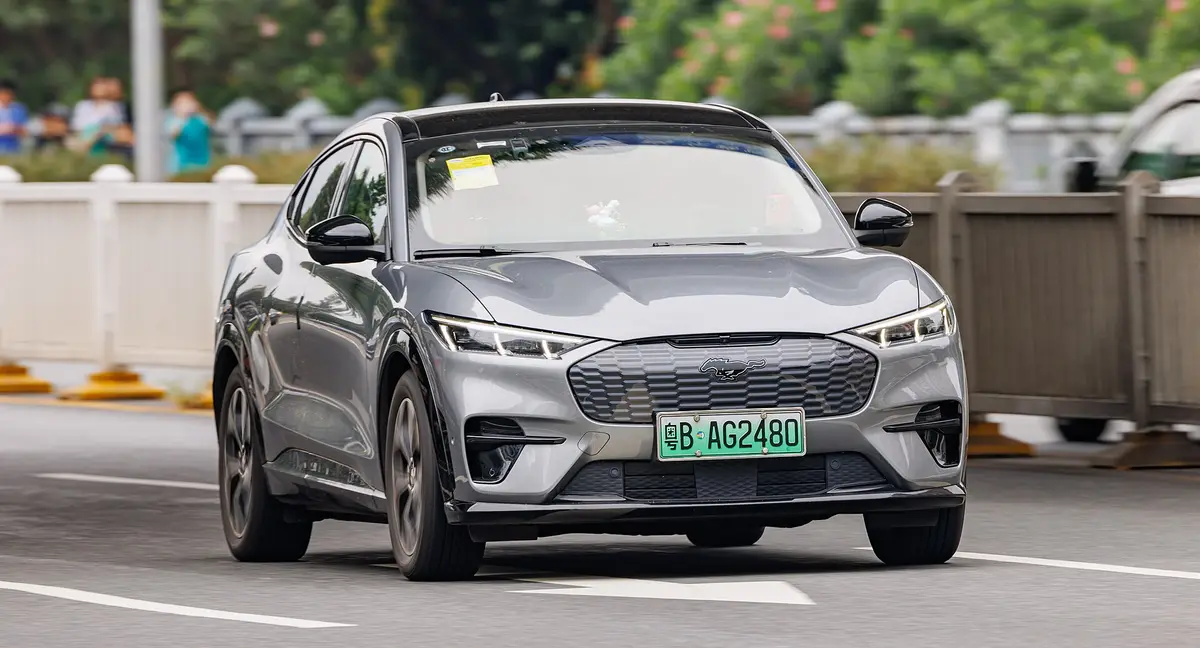
2021 Ford Mustang Mach-E: EPA range up to 305 miles, 13 NHTSA recall campaigns, 353 owner complaints on file. Figures below are quoted from the source named under each one. Updated November 19, 2026.
EPA range and efficiency
EPA tested 7 battery-electric configurations for this model year. Range is the agency's lab result in miles. kWh per 100 miles is the energy the same test used. MPGe is miles per gallon equivalent, which EPA still prints on the label. EPA's annual fuel-cost estimate for the Mustang Mach-E RWD California Route 1 is $750. That is an energy-cost figure for a new car on EPA's assumptions, not a used price.
| Trim in the EPA file | Drive | Range mi | Comb. MPGe | kWh/100 mi | 240V hours |
|---|---|---|---|---|---|
| Mustang Mach-E RWD California Route 1 | Rear-Wheel Drive | 305 | 101 | 33.3 | 11.4 |
| Mustang Mach-E RWD Extended | Rear-Wheel Drive | 300 | 97 | 34.6 | 10.9 |
| Mustang Mach-E AWD Extended | All-Wheel Drive | 270 | 90 | 37.3 | 10.7 |
| Mustang Mach-E GT | All-Wheel Drive | 270 | 84 | 40.2 | 10.3 |
| Mustang Mach-E GT Performance | All-Wheel Drive | 260 | 82 | 41.2 | 10.1 |
| Mustang Mach-E RWD | Rear-Wheel Drive | 230 | 100 | 33.9 | 8.8 |
| Mustang Mach-E AWD | All-Wheel Drive | 211 | 93 | 36.4 | 8.5 |
Source: U.S. EPA and DOE FuelEconomy.gov vehicles file, retrieved November 19, 2026. vehicles.csv. Each trim links to its FuelEconomy.gov record.
Recalls, in plain language
These are NHTSA campaign records for this model year, not a repair status for one car. The summary, consequence, and remedy are NHTSA's words.
Campaign 21V140000
Campaign 21V140000 is filed under SUSPENSION:SUBFRAME/MOUNTING BRACKET.
NHTSA summary. Ford Motor Company (Ford) is recalling certain 2021 Mustang Mach-E vehicles. The front subframe bolts may not have been tightened properly during assembly, which could result in loose bolts.
Consequence. Loose subframe bolts may reduce the vehicle's performance in a crash, increasing the risk of injury.
Remedy. Ford will notify owners, and dealers will inspect the front subframe bolts and tighten them as necessary, free of charge. The recall began April 2, 2021. Owners may contact Ford customer service at 1-866-436-7332. Ford's number for this recall is 21S09.
Report received date on the API: March 5, 2021. Raw value: 05/03/2021. Recall query.
Campaign 21V711000
Campaign 21V711000 is filed under VISIBILITY:WINDSHIELD.
NHTSA summary. Ford Motor Company (Ford) is recalling certain 2021 Mustang Mach-E vehicles. The windshield may not have been properly bonded to the vehicle, which could allow it to detach. As such, these vehicles fail to comply with the requirements of Federal Motor Vehicle Safety Standard number 212, "Windshield Mounting."
Consequence. A windshield that separates from a vehicle during a crash can increase the risk of injury.
Remedy. Dealers will remove and reinstall the windshield, free of charge. Owner notification letters were mailed on October 29, 2021. Owners may contact Ford customer service at 1-866-436-7332. Ford's number for this recall is 21C22.
Report received date on the API: September 14, 2021. Raw value: 14/09/2021. Recall query.
Campaign 21V712000
Campaign 21V712000 is filed under VISIBILITY:FIXED PANARAMIC ROOF/SKY LIGHT ASSEMBLY.
NHTSA summary. Ford Motor Company (Ford) is recalling certain 2021 Mustang Mach-E vehicles. The vehicle's panoramic roof glass panel may not have been properly bonded to the vehicle, which could allow it to detach.
Consequence. A roof panel that separates from a vehicle can become a road hazard, increasing the risk of a crash or injury.
Remedy. Dealers will apply additional urethane adhesive, free of charge. Owner notification letters were mailed October 29, 2021. Owners may contact Ford customer service at 1-866-436-7332. Ford's number for this recall is 21S42.
Report received date on the API: September 14, 2021. Raw value: 14/09/2021. Recall query.
Campaign 21V979000
Campaign 21V979000 is filed under SEAT BELTS:REAR/OTHER:ANCHORAGE.
NHTSA summary. Ford Motor Company (Ford) is recalling certain 2021-2022 Mustang Mach-E and 2022 Maverick vehicles. The rear seat belt buckles may not be properly attached to the rear floor assembly. As such, these vehicles fail to comply with the requirements of Federal Motor Vehicle Safety Standard numbers 208, "Occupant Crash Protection," and 210, "Seat Belt Assembly Anchorages."
Consequence. Improperly attached seat belts may not adequately restrain an occupant in a crash, increasing the risk of injury.
Remedy. Dealers will repair the rear seat belt buckle attachments, free of charge. Owner notification letters were mailed January 28, 2022. Owners may contact Ford customer service at 1-866-436-7332. Ford's number for this recall is 21C36.
Report received date on the API: December 16, 2021. Raw value: 16/12/2021. Recall query.
Campaign 22V333000
Over the air
Campaign 22V333000 is filed under VEHICLE SPEED CONTROL. NHTSA marks the remedy as an over-the-air software update.
NHTSA summary. Ford Motor Company (Ford) is recalling certain 2021 Mustang Mach-E vehicles equipped with all-wheel drive. The powertrain control module (PCM) functional safety software may fail to detect a software error, resulting in unintended acceleration, unintended deceleration, or a loss of drive power.
Consequence. Unintended acceleration, unintended deceleration, or a loss of drive power increases the risk of a crash.
Remedy. The PCM software will be updated by a dealer, or through an over-the-air (OTA) update, free of charge. Owner notification letters were mailed June 9, 2022. Owners may contact Ford customer service at 1-800-436-7332. Ford's number for this recall is 22S29.
Report received date on the API: May 13, 2022. Raw value: 13/05/2022. Recall query.
Campaign 22V412000
Campaign 22V412000 is filed under ELECTRICAL SYSTEM:PROPULSION SYSTEM:TRACTION BATTERY:MANAGEMENT SYSTEM/ENERGY CONTROL MODULE (BMS/BECM):SOFTWARE.
NHTSA summary. Ford Motor Company (Ford) is recalling certain 2021-2022 Mustang Mach-E vehicles. The high voltage battery main contactors may overheat.
Consequence. An overheated high voltage battery contactor may cause the vehicle to lose drive power, increasing the risk of a crash.
Remedy. Dealers will update the on-board software, free of charge. Owner notification letters were mailed on July 8, 2022. Owners may contact Ford customer service at 1-866-436-7332. Ford's number for this recall is 22S41.
Report received date on the API: June 10, 2022. Raw value: 10/06/2022. Recall query.
Campaign 23V687000
Campaign 23V687000 is filed under ELECTRICAL SYSTEM:PROPULSION SYSTEM:TRACTION BATTERY:MANAGEMENT SYSTEM/ENERGY CONTROL MODULE (BMS/BECM).
NHTSA summary. Ford Motor Company (Ford) is recalling certain 2021-2022 Mustang Mach-E vehicles equipped with an extended range battery. The high voltage battery main contactors may overheat.
Consequence. An overheated high voltage battery contactor can result in a loss of drive power, increasing the risk of a crash.
Remedy. Dealers will replace the high voltage battery junction box, free of charge. Owner notification letters were mailed December 29, 2023. Owners may contact Ford customer service at 1-866-436-7332. Ford's number for this recall is 23S56. Vehicles included in this recall that were previously repaired under recall 22V-412 will need to have the new remedy completed.
Report received date on the API: October 13, 2023. Raw value: 13/10/2023. Recall query.
Campaign 24V777000
Campaign 24V777000 is filed under SERVICE BRAKES, HYDRAULIC:ANTILOCK/TRACTION CONTROL/ELECTRONIC LIMITED SLIP:CONTROL UNIT/MODULE.
NHTSA summary. Ford Motor Company (Ford) is recalling certain 2021 Mach-E vehicles. An Over-The-Air (OTA) update to the Anti-lock Braking System (ABS) may result in a loss of power brake assist, ABS, Electronic Stability Control, Traction Control, and driver assistance features.
Consequence. A loss of power brake assist can extend the distance required to stop the vehicle. Additionally, a disabled antilock brake system and/or stability control system can result in a loss of vehicle control. Either of these scenarios can increase the risk of a crash.
Remedy. Dealers will update the ABS calibration, free of charge. Owner notification letters were mailed November 5, 2024. Owners may contact Ford customer service at 1-866-436-7332. Ford's number for this recall is 24S65.
Report received date on the API: October 18, 2024. Raw value: 18/10/2024. Recall query.
Campaign 25V130000
Campaign 25V130000 is filed under ELECTRICAL SYSTEM:PROPULSION SYSTEM:TRACTION BATTERY:MANAGEMENT SYSTEM/ENERGY CONTROL MODULE (BMS/BECM):SOFTWARE.
NHTSA summary. Ford Motor Company (Ford) is recalling certain 2021-2022 Mustang Mach-E vehicles previously repaired incorrectly under recall number 22V-412. The high voltage battery main contactors may overheat.
Consequence. An overheated high voltage battery contactor may cause the vehicle to lose drive power, increasing the risk of a crash.
Remedy. Dealers will update the on-board software, free of charge. Owner notification letters were mailed April 11, 2025. Owners may contact Ford customer service at 1-866-436-7332. Ford's number for this recall is 25S14.
Report received date on the API: March 1, 2025. Raw value: 01/03/2025. Recall query.
Campaign 25V315000
Campaign 25V315000 is filed under BACK OVER PREVENTION:SOFTWARE.
NHTSA summary. Ford Motor Company (Ford) is recalling certain 2021-2024 Bronco, F-150, 2021-2024 Edge, 2022-2025 Escape, F-250, F-350, F-450, F-550, F-600, 2022-2024 Expedition, 2022-2025 Transit, 2021-2023 Mach-E, 2024 Ranger, Mustang, 2021-2023 Lincoln Nautilus, 2022-2024 Navigator, and 2023-2024 Corsair vehicles. A software error may cause the rearview camera image to delay, freeze, or not display when the vehicle is in reverse.
Consequence. A frozen or missing rearview camera image can reduce the driver's view behind the vehicle, increasing the risk of a crash.
Remedy. The accessory protocol interface module (APIM) software will be updated by a dealer or through an over-the-air update, free of charge. This will be a phased campaign, with the remedy becoming available in different phases based on model and model years. Interim letters notifying owners of the safety risk were mailed on June 26, 2025. Additional letters will be mailed once the final remedy is available on each phase. Owner notification letters were sent on October 8, 2025. Owners may contact Ford customer service at 1-866-436-7332. Ford's number for this recall is 25S49.
Report received date on the API: May 9, 2025. Raw value: 09/05/2025. Recall query.
Campaign 25V404000
Campaign 25V404000 is filed under ELECTRICAL SYSTEM:BODY CONTROL MODULE:SOFTWARE.
NHTSA summary. Ford Motor Company (Ford) is recalling certain 2021-2025 Mustang Mach E vehicles. In the event of a low battery charge, the electronic door latches may remain locked once the driver or front passenger exits and shuts the door, possibly trapping someone who is unable to use the inside door release handles, such as a child in the back seat.
Consequence. The inability to enter or exit the vehicle in an emergency increases the risk of injury.
Remedy. Dealers will update the Powertrain Control Module (PCM) and the Secondary On-Board Diagnostic Control Module C (SOBDMC) software, free of charge. Owner notification letters were mailed to 2021-2025 Mustang Mach-E owners September 12, 2025. Additionally, Owner notification letters were mailed to 2024-2025 Mustang Mach-E owners July 10, 2025. Owners may contact Ford customer service at 1-866-436-7332. Ford's number for this recall is 25S65.
Report received date on the API: June 13, 2025. Raw value: 13/06/2025. Recall query.
Campaign 25V513000
Campaign 25V513000 is filed under SERVICE BRAKES, HYDRAULIC:ANTILOCK/TRACTION CONTROL/ELECTRONIC LIMITED SLIP:CONTROL UNIT/MODULE.
NHTSA summary. Ford Motor Company (Ford) is recalling certain 2021 Mach-E vehicles that were repaired incorrectly under recall 24V777. An Over-The-Air (OTA) update to the Anti-lock Braking System (ABS) may result in a loss of power brake assist, ABS, Electronic Stability Control, Traction Control, and driver assistance features.
Consequence. A loss of power brake assist can increase the distance required to stop the vehicle. Additionally, a disabled antilock brake system and/or stability control system can result in a loss of vehicle control. Either of these scenarios can increase the risk of a crash.
Remedy. Dealers will update the ABS calibration software, free of charge. Owner notification letters were mailed September 18, 2025. Owners may contact Ford customer service at 1-866-436-7332. Ford's number for this recall is 25S81.
Report received date on the API: August 8, 2025. Raw value: 08/08/2025. Recall query.
Campaign 26V417000
Campaign 26V417000 is filed under POWER TRAIN:DRIVELINE:DIFFERENTIAL UNIT.
NHTSA summary. Ford Motor Company (Ford) is recalling certain 2021-2023 Mustang Mach E vehicles. The rear differential pinion shaft may fracture.
Consequence. Differential pinion shaft fracture may result in a loss of drive power, or unintended vehicle movement if the vehicle is in park without the parking brake applied, increasing the risk of a crash.
Remedy. Dealers will repair or replace the rear differential assembly as necessary, free of charge. Interim letters, notifying owners of the safety risk, were mailed July 13, 2026. Additional letters will be sent once the remedy is available, anticipated in late December 2026. Owners may contact Ford customer service at 1-866-436-7332. Ford's number for this recall is 26S50.
Report received date on the API: June 30, 2026. Raw value: 30/06/2026. Recall query.
Recall source: NHTSA recallsByVehicle, names queried include mustang mach-e (HTTP 400), mustang mach e (HTTP 200).
Owner complaints by component
NHTSA has 353 complaints on file for mustang mach-e, counting each ODI number once. Of those, 15 filings included a crash flag, 1 included a fire flag, the injury fields sum to 9. These are flags on the complaint form, not a completed crash investigation.
| Top-level component | Complaints |
|---|---|
| ELECTRICAL SYSTEM | 156 |
| FORWARD COLLISION AVOIDANCE | 106 |
| POWER TRAIN | 53 |
| UNKNOWN OR OTHER | 50 |
| FUEL/PROPULSION SYSTEM | 49 |
| VEHICLE SPEED CONTROL | 37 |
| LANE DEPARTURE | 32 |
| SERVICE BRAKES | 32 |
| ENGINE | 17 |
| STEERING | 15 |
| VISIBILITY/WIPER | 11 |
| VISIBILITY | 10 |
A complaint that lists two systems is counted under each top-level system. The total above counts the filing once. Component names are NHTSA's. Query example: api.nhtsa.gov/complaints/complaintsByVehicle?make=FORD&model=mustang%20mach-e&modelYear=2021.
Battery health
Nothing in this section is a measurement of a 2021 Ford Mustang Mach-E. kWhWise does not have a public per-model battery dataset, so this is the fleet finding we can cite, not a reading from the car you are looking at.
Geotab's January 13, 2026 update, covering more than 22,700 electric vehicles and 21 models, puts average battery degradation at 2.3% per year. On that average, Geotab projects about 81.6% of original capacity left after eight years. The same write-up says the average is not the whole story: light cars in the study averaged 2.0% a year, and multi-purpose vehicles averaged 2.7%.
Charging power moved the number. Vehicles that relied on DC fast charging above 100 kW averaged up to 3.0% a year, against about 1.5% for vehicles charged mostly at lower power. Hot climates added about 0.4 percentage point a year versus mild climates. Geotab also says the loss is not a straight line. Many packs drop faster in the first year or two, then slow down. Do not multiply 2.3% by this car's age and treat the result as its state of health.
Ask the seller for a battery-health readout from the car's service menu or from a shop, plus any record of a pack repair or replacement. Warranty terms differ by model year. Check the warranty booklet or the manufacturer's site. This page does not restate a warranty we have not cited from the maker.
Sources: New Geotab data shows EV battery health remains strong as fast charging use increases (January 13, 2026) and EV battery health: what 22,700 vehicles showed.
What to check before you buy
The first items follow the complaint and recall components for this model year. The last items are a general EV inspection. They are not statistics.
- ELECTRICAL SYSTEM is the subject of 156 complaints in this model year. Ask about propulsion faults, charge failures, and 12-volt battery replacements. Start the car and watch for warning lights.
- FORWARD COLLISION AVOIDANCE is the subject of 106 complaints in this model year. Ask if driver-assist features were updated or turned off. Try adaptive cruise on a quiet road if the car has it.
- POWER TRAIN is the subject of 53 complaints in this model year. Ask for any motor, gearbox, or drivetrain repair records and whether the car has ever refused to go into Drive.
- Ask for proof that these recall components were handled: SUSPENSION:SUBFRAME/MOUNTING BRACKET; VISIBILITY:WINDSHIELD; VISIBILITY:FIXED PANARAMIC ROOF/SKY LIGHT ASSEMBLY. A campaign number is not the same thing as a completed repair.
- Look up the VIN on NHTSA's own recall site before you pay. This page is a model-year summary, not a VIN history.
- Charge the car well up and compare the dash range guess with the EPA figures below. The dash number is not the EPA test.
- Inspect the charge-port pins for heat marks or bending, and confirm which charge cord, if any, comes with the car.
- Run the heater and the air conditioner. Both pull from the high-voltage system.
Charging
kWhWise does not yet publish a charge-inlet type for this model. We do not have a year-by-year public inlet dataset in this build, and the 2025 switch to NACS on many brands makes a single label easy to get wrong. Match the inlet on the car to the connector mix on the state and city pages.
EPA publishes a 240-volt charge time for 7 trims of the 2021 Mustang Mach-E. The Mustang Mach-E RWD California Route 1 figure is 11.4 hours. That is EPA's number, from empty toward full on the charger they assumed. Prefer it over the estimate in the next paragraph.
Where range and combined consumption are both present, we also show an estimate: implied usable energy (kWh) = EPA miles × EPA combined kWh per 100 miles / 100. Hours at 7.2 kW = that energy / 7.2. The 7.2 kW figure is a common 240-volt, 30-amp home circuit, not a rating of this car. The estimate ignores charging losses, cold weather, and the slowdown near full. It is not the manufacturer's gross pack size.
| Trim | EPA 240V hours | EPA charger note | Implied kWh | Est. hours at 7.2 kW |
|---|---|---|---|---|
| Mustang Mach-E RWD California Route 1 | 11.4 | 101.6 | 14.1 | |
| Mustang Mach-E RWD Extended | 10.9 | 103.8 | 14.4 | |
| Mustang Mach-E AWD Extended | 10.7 | 100.7 | 14.0 | |
| Mustang Mach-E GT | 10.3 | 108.5 | 15.1 | |
| Mustang Mach-E GT Performance | 10.1 | 107.1 | 14.9 | |
| Mustang Mach-E RWD | 8.8 | 78.0 | 10.8 | |
| Mustang Mach-E AWD | 8.5 | 76.8 | 10.7 |
EPA's motor descriptions: Mustang Mach-E RWD California Route 1: 216 kW ACPM. Mustang Mach-E RWD Extended: 216 kW AC PMSM. Mustang Mach-E AWD Extended: 209 and 209 kW AC PMSM. Mustang Mach-E GT: 179 and 179 kW AC PMSM. Mustang Mach-E GT Performance: 179 and 179 kW AC PMSM. Mustang Mach-E RWD: 198 kW AC PMSM. Mustang Mach-E AWD: 198 and 198 kW AC PMSM.
Keep reading
- Ford Mustang Mach-E overview
- Which Mustang Mach-E years have fewer complaints, and which have more recalls
- Charging a used Ford Mustang Mach-E
- Other model years: 2022, 2023, 2024, 2025, 2026
- Compare with the Tesla Model Y
- Compare with the Hyundai Ioniq 5
- Compare with the Kia EV6
- Compare with the Volkswagen ID.4
- Public charging in California (2,784 DC fast sites in the AFDC snapshot)
- Public charging in Florida (947 DC fast sites in the AFDC snapshot)
- Public charging in Texas (921 DC fast sites in the AFDC snapshot)
Questions this page can answer
What is the EPA range of the 2021 Ford Mustang Mach-E?
In the FuelEconomy.gov file, the longest range for this model year is 305 miles, on the Mustang Mach-E RWD California Route 1. Other trims are in the table on this page. EPA range is a lab result, not a winter highway promise.
How many NHTSA recalls are on the 2021 Mustang Mach-E?
NHTSA's recalls API returned 13 campaigns for the model name we queried, after duplicate campaign numbers were removed. Campaign numbers are listed on this page. Check the specific VIN before you buy.
How many owner complaints does NHTSA have for the 2021 Mustang Mach-E?
NHTSA returned 353 complaints for the matched model names, deduped by ODI number. This is a filing count, not a failure rate. We do not divide by sales.
How long does home charging take on a 2021 Mustang Mach-E?
EPA lists 11.4 hours on 240 volts for the Mustang Mach-E RWD California Route 1, and our 7.2 kW estimate for that trim is 14.1 hours, labeled as an estimate. See the charging section for every trim we have.
How much energy does the 2021 Mustang Mach-E use?
The lowest combined figure in the EPA file for this year is 33.3 kWh per 100 miles, on the Mustang Mach-E RWD California Route 1. Lower means the test used less energy to cover the same distance.
Sources on this page
- EPA / FuelEconomy.gov vehicles.csv, retrieved November 19, 2026.
- NHTSA recalls and complaints APIs, retrieved with this snapshot on November 19, 2026.
- Geotab EV battery health and the January 13, 2026 press release.
- Page first released November 19, 2026. Canonical: https://kwhwise.com/used/ford/mustang-mach-e/2021/.