Used EV · SUV · 2026
2026 Subaru Solterra
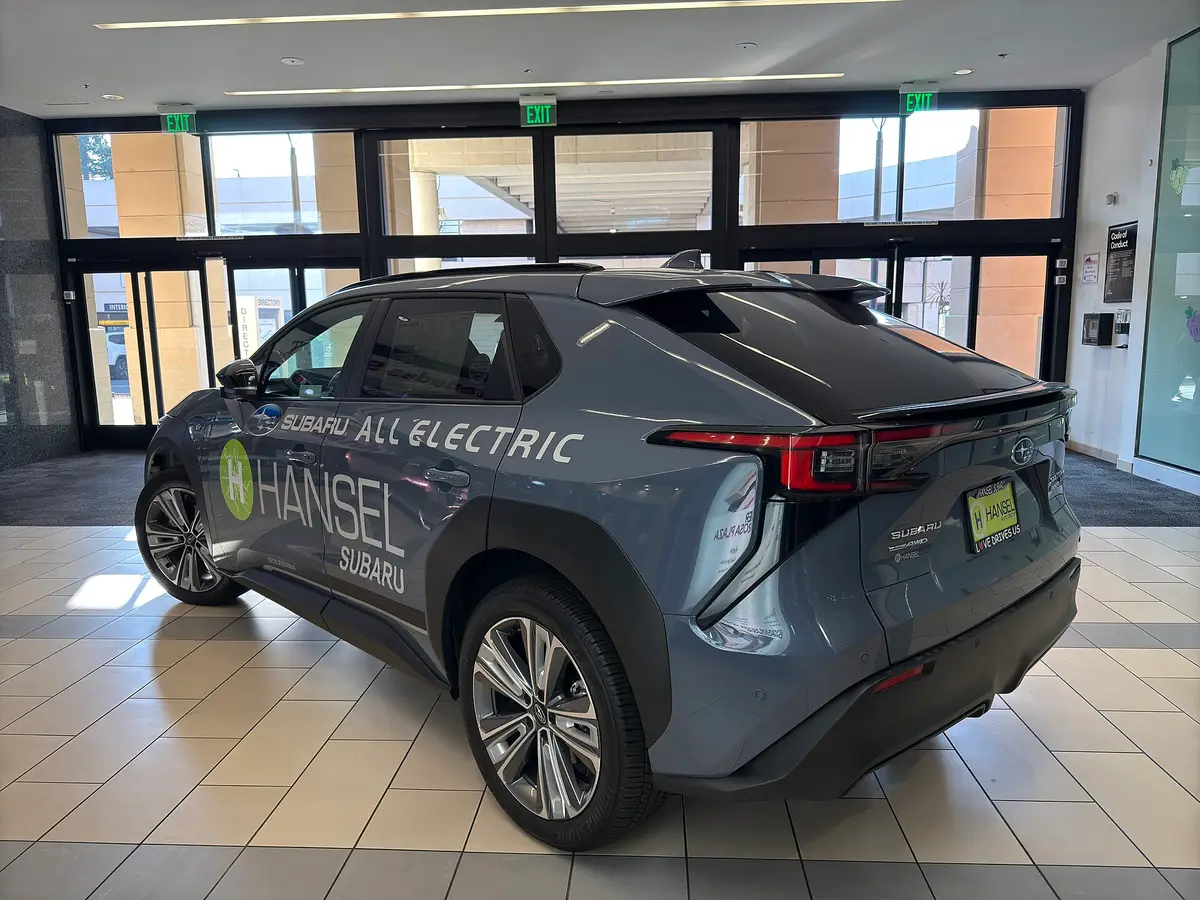
2026 Subaru Solterra: EPA range up to 288 miles, 1 NHTSA recall campaign, 19 owner complaints on file. Figures below are quoted from the source named under each one. Updated November 19, 2026.
EPA range and efficiency
EPA tested 2 battery-electric configurations for this model year. Range is the agency's lab result in miles. kWh per 100 miles is the energy the same test used. MPGe is miles per gallon equivalent, which EPA still prints on the label. EPA's annual fuel-cost estimate for the Solterra AWD is $650. That is an energy-cost figure for a new car on EPA's assumptions, not a used price.
| Trim in the EPA file | Drive | Range mi | Comb. MPGe | kWh/100 mi | 240V hours |
|---|---|---|---|---|---|
| Solterra AWD | All-Wheel Drive | 288 | 120 | 28.0 | 8.0 |
| Solterra 20 AWD | All-Wheel Drive | 278 | 117 | 28.9 | 8.0 |
Source: U.S. EPA and DOE FuelEconomy.gov vehicles file, retrieved November 19, 2026. vehicles.csv. Each trim links to its FuelEconomy.gov record.
Recalls, in plain language
These are NHTSA campaign records for this model year, not a repair status for one car. The summary, consequence, and remedy are NHTSA's words.
Campaign 26V393000
Campaign 26V393000 is filed under ELECTRICAL SYSTEM:PROPULSION SYSTEM.
NHTSA summary. Toyota Motor Engineering & Manufacturing (Toyota) is recalling certain 2026 Toyota BZ, Lexus RZ, and Subaru Solterra battery electric vehicles. The electronic control unit (ECU) that controls the high voltage battery may experience a fault, resulting in a loss of drive power.
Consequence. An unexpected loss of drive power increases the risk of a crash.
Remedy. Dealers will update the battery ECU software, free of charge. Owner notification letters were mailed August 17, 2026. Owners may contact Toyota's customer service at 1-800-331-4331. Toyota's numbers for this recall are 26LA07 and 26TA11. Subaru's number for this recall is WRG26.
Report received date on the API: June 18, 2026. Raw value: 18/06/2026. Recall query.
Recall source: NHTSA recallsByVehicle, names queried include solterra (HTTP 200).
Owner complaints by component
NHTSA has 19 complaints on file for SOLTERRA, counting each ODI number once.
| Top-level component | Complaints |
|---|---|
| ELECTRICAL SYSTEM | 11 |
| UNKNOWN OR OTHER | 4 |
| EXTERIOR LIGHTING | 3 |
| ENGINE | 1 |
| FORWARD COLLISION AVOIDANCE | 1 |
| FUEL/PROPULSION SYSTEM | 1 |
| LANE DEPARTURE | 1 |
| SERVICE BRAKES | 1 |
A complaint that lists two systems is counted under each top-level system. The total above counts the filing once. Component names are NHTSA's. Query example: api.nhtsa.gov/complaints/complaintsByVehicle?make=SUBARU&model=SOLTERRA&modelYear=2026.
Battery health
Nothing in this section is a measurement of a 2026 Subaru Solterra. kWhWise does not have a public per-model battery dataset, so this is the fleet finding we can cite, not a reading from the car you are looking at.
Geotab's January 13, 2026 update, covering more than 22,700 electric vehicles and 21 models, puts average battery degradation at 2.3% per year. On that average, Geotab projects about 81.6% of original capacity left after eight years. The same write-up says the average is not the whole story: light cars in the study averaged 2.0% a year, and multi-purpose vehicles averaged 2.7%.
Charging power moved the number. Vehicles that relied on DC fast charging above 100 kW averaged up to 3.0% a year, against about 1.5% for vehicles charged mostly at lower power. Hot climates added about 0.4 percentage point a year versus mild climates. Geotab also says the loss is not a straight line. Many packs drop faster in the first year or two, then slow down. Do not multiply 2.3% by this car's age and treat the result as its state of health.
Ask the seller for a battery-health readout from the car's service menu or from a shop, plus any record of a pack repair or replacement. Warranty terms differ by model year. Check the warranty booklet or the manufacturer's site. This page does not restate a warranty we have not cited from the maker.
Sources: New Geotab data shows EV battery health remains strong as fast charging use increases (January 13, 2026) and EV battery health: what 22,700 vehicles showed.
What to check before you buy
The first items follow the complaint and recall components for this model year. The last items are a general EV inspection. They are not statistics.
- ELECTRICAL SYSTEM is the subject of 11 complaints in this model year. Ask about propulsion faults, charge failures, and 12-volt battery replacements. Start the car and watch for warning lights.
- UNKNOWN OR OTHER shows up in 4 complaints. Ask the seller what was repaired under that system.
- EXTERIOR LIGHTING shows up in 3 complaints. Ask the seller what was repaired under that system.
- Ask for proof that these recall components were handled: ELECTRICAL SYSTEM:PROPULSION SYSTEM. A campaign number is not the same thing as a completed repair.
- Look up the VIN on NHTSA's own recall site before you pay. This page is a model-year summary, not a VIN history.
- Charge the car well up and compare the dash range guess with the EPA figures below. The dash number is not the EPA test.
- Inspect the charge-port pins for heat marks or bending, and confirm which charge cord, if any, comes with the car.
- Run the heater and the air conditioner. Both pull from the high-voltage system.
Charging
kWhWise does not yet publish a charge-inlet type for this model. We do not have a year-by-year public inlet dataset in this build, and the 2025 switch to NACS on many brands makes a single label easy to get wrong. Match the inlet on the car to the connector mix on the state and city pages.
EPA publishes a 240-volt charge time for 2 trims of the 2026 Solterra. The Solterra AWD figure is 8.0 hours. That is EPA's number, from empty toward full on the charger they assumed. Prefer it over the estimate in the next paragraph.
Where range and combined consumption are both present, we also show an estimate: implied usable energy (kWh) = EPA miles × EPA combined kWh per 100 miles / 100. Hours at 7.2 kW = that energy / 7.2. The 7.2 kW figure is a common 240-volt, 30-amp home circuit, not a rating of this car. The estimate ignores charging losses, cold weather, and the slowdown near full. It is not the manufacturer's gross pack size.
| Trim | EPA 240V hours | EPA charger note | Implied kWh | Est. hours at 7.2 kW |
|---|---|---|---|---|
| Solterra AWD | 8.0 | 80.6 | 11.2 | |
| Solterra 20 AWD | 8.0 | 80.3 | 11.2 |
EPA's motor descriptions: Solterra AWD: 87 and 167 kW AC Synchronous. Solterra 20 AWD: 87 and 167 kW AC Synchronous.
Keep reading
- Subaru Solterra overview
- Which Solterra years have fewer complaints, and which have more recalls
- Charging a used Subaru Solterra
- Other model years: 2023, 2024, 2025, 2027
- Compare with the Toyota bZ4X
- Public charging in California (2,784 DC fast sites in the AFDC snapshot)
- Public charging in Florida (947 DC fast sites in the AFDC snapshot)
- Public charging in Texas (921 DC fast sites in the AFDC snapshot)
Questions this page can answer
What is the EPA range of the 2026 Subaru Solterra?
In the FuelEconomy.gov file, the longest range for this model year is 288 miles, on the Solterra AWD. Other trims are in the table on this page. EPA range is a lab result, not a winter highway promise.
How many NHTSA recalls are on the 2026 Solterra?
NHTSA's recalls API returned 1 campaign for the model name we queried, after duplicate campaign numbers were removed. Campaign numbers are listed on this page. Check the specific VIN before you buy.
How many owner complaints does NHTSA have for the 2026 Solterra?
NHTSA returned 19 complaints for the matched model names, deduped by ODI number. This is a filing count, not a failure rate. We do not divide by sales.
How long does home charging take on a 2026 Solterra?
EPA lists 8.0 hours on 240 volts for the Solterra AWD, and our 7.2 kW estimate for that trim is 11.2 hours, labeled as an estimate. See the charging section for every trim we have.
How much energy does the 2026 Solterra use?
The lowest combined figure in the EPA file for this year is 28.0 kWh per 100 miles, on the Solterra AWD. Lower means the test used less energy to cover the same distance.
Sources on this page
- EPA / FuelEconomy.gov vehicles.csv, retrieved November 19, 2026.
- NHTSA recalls and complaints APIs, retrieved with this snapshot on November 19, 2026.
- Geotab EV battery health and the January 13, 2026 press release.
- Page first released November 19, 2026. Canonical: https://kwhwise.com/used/subaru/solterra/2026/.