Used EV · Car · 2021
2021 Tesla Model 3
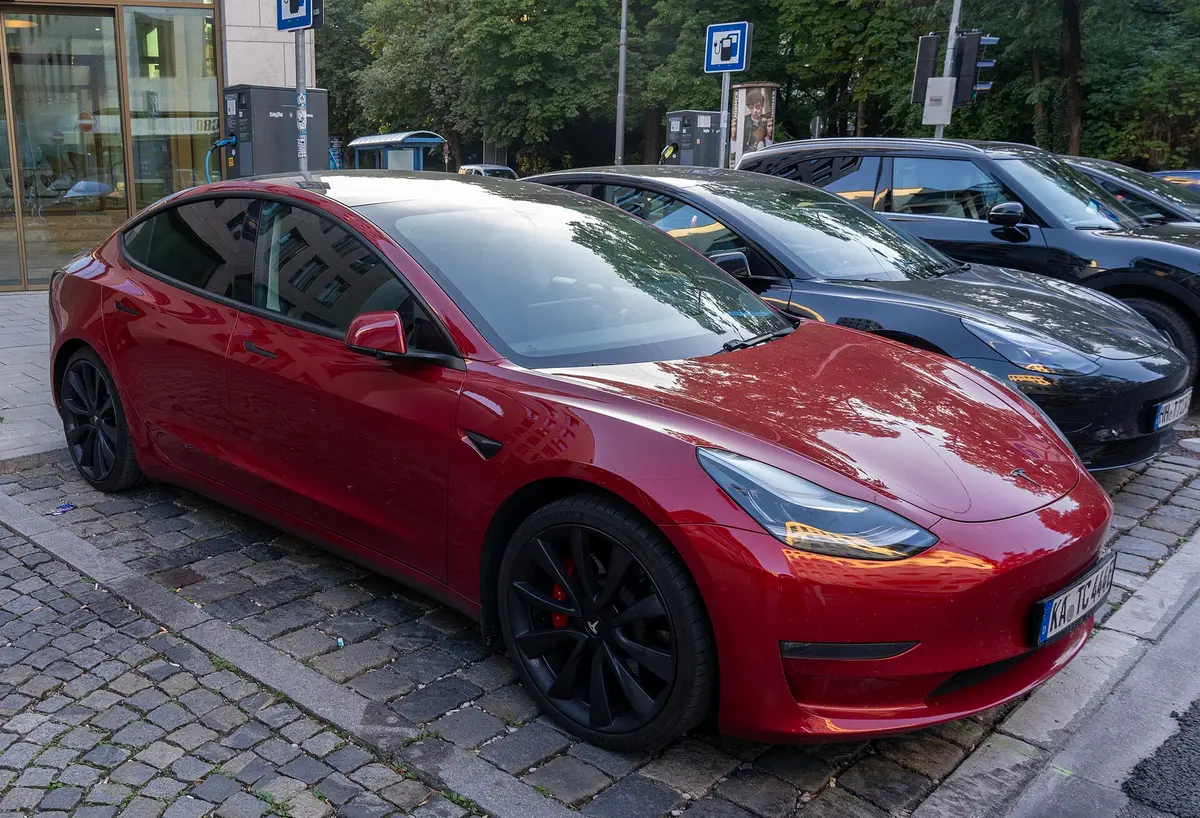
2021 Tesla Model 3: EPA range up to 353 miles, 22 NHTSA recall campaigns, 680 owner complaints on file. Figures below are quoted from the source named under each one. Updated November 19, 2026.
EPA range and efficiency
EPA tested 3 battery-electric configurations for this model year. Range is the agency's lab result in miles. kWh per 100 miles is the energy the same test used. MPGe is miles per gallon equivalent, which EPA still prints on the label. EPA's annual fuel-cost estimate for the Model 3 Long Range AWD is $550. That is an energy-cost figure for a new car on EPA's assumptions, not a used price.
| Trim in the EPA file | Drive | Range mi | Comb. MPGe | kWh/100 mi | 240V hours |
|---|---|---|---|---|---|
| Model 3 Long Range AWD | All-Wheel Drive | 353 | 134 | 25.1 | 11.2 |
| Model 3 Performance AWD | All-Wheel Drive | 315 | 113 | 30.0 | 11.6 |
| Model 3 Standard Range Plus RWD | Rear-Wheel Drive | 263 | 142 | 23.7 | 7.8 |
Source: U.S. EPA and DOE FuelEconomy.gov vehicles file, retrieved November 19, 2026. vehicles.csv. Each trim links to its FuelEconomy.gov record.
Recalls, in plain language
These are NHTSA campaign records for this model year, not a repair status for one car. The summary, consequence, and remedy are NHTSA's words.
Campaign 21V387000
Campaign 21V387000 is filed under SERVICE BRAKES, HYDRAULIC:FOUNDATION COMPONENTS:DISC:CALIPER.
NHTSA summary. Tesla, Inc. (Tesla) is recalling certain 2019-2021 Model 3 and 2020-2021 Model Y vehicles. The brake caliper bolts may be loose, allowing the brake caliper to separate and contact the wheel rim.
Consequence. Contact with the rim may cause a loss of tire pressure, increasing the risk of a crash.
Remedy. Tesla Service will inspect and tighten, or replace the caliper bolts as necessary, free of charge. Owner notification letters were mailed July 23, 2021. Owners may contact Tesla customer service online by visiting www.tesla.com/support/contact or by calling 1-877-79-TESLA (or 1-877-798-3752). Tesla's number for this recall is SB-21-33-002.
Report received date on the API: May 25, 2021. Raw value: 25/05/2021. Recall query.
Campaign 21V834000
Campaign 21V834000 is filed under AIR BAGS:SIDE/WINDOW:CURTAIN.
NHTSA summary. Tesla, Inc. (Tesla) is recalling certain 2020-2021, 2023 Model 3 vehicles. The left and/or right side curtain air bag may have been improperly secured to the roof rail, which could result in a twisted air bag. As such, these vehicles fail to comply with the requirements of Federal Motor Vehicle Safety Standard numbers 214, "Side Impact Protection" and 226, "Ejection Mitigation."
Consequence. A twisted side curtain air bag may improperly deploy, increasing the risk of injury or occupant ejection during a crash.
Remedy. Tesla Service will inspect and realign the left and right side curtain air bag as necessary, free of charge. Owner notification letters were mailed December 23, 2021. Owners may contact Tesla customer service at 1-877-798-3752. Tesla's number for this recall is SB-21-20-006.
Report received date on the API: October 25, 2021. Raw value: 25/10/2021. Recall query.
Campaign 21V835000
Campaign 21V835000 is filed under SUSPENSION:CRITICAL FASTENERS.
NHTSA summary. Tesla, Inc. (Tesla) is recalling certain 2020-2021 Model Y and 2019-2021 Model 3 vehicles. The front suspension lateral link fasteners may loosen, allowing the lateral link to separate from the sub-frame.
Consequence. A lateral link separation could shift the wheel alignment, causing instability and increasing the risk of a crash.
Remedy. Tesla Service will tighten or replace the lateral link fasteners as necessary, free of charge. Owner notification letters were mailed December 20, 2021. Owners may contact Tesla customer service at 1-877-798-3752. Tesla's number for this recall is SB-21-31-003.
Report received date on the API: October 25, 2021. Raw value: 25/10/2021. Recall query.
Campaign 21V846000
Over the air
Campaign 21V846000 is filed under FORWARD COLLISION AVOIDANCE: SENSING SYSTEM: CAMERA. NHTSA marks the remedy as an over-the-air software update.
NHTSA summary. Tesla, Inc. (Tesla) is recalling certain 2017-2021 Model S, Model 3, Model X, and 2020-2021 Model Y vehicles operating software version 2021.36.5.2. A communication error may cause false forward-collision warning (FCW) or unexpected activation of the automatic emergency brake (AEB) system.
Consequence. Unexpected activation of the AEB system may cause the car to stop suddenly, increasing the risk of a crash.
Remedy. Tesla Service has released an over-the-air (OTA) software update, free of charge. The recall began October 25, 2021. Owners may contact Tesla customer service at 1-877-798-3752. Tesla's number for this recall is SB-21-00-004.
Report received date on the API: October 29, 2021. Raw value: 29/10/2021. Recall query.
Campaign 22V037000
Over the air
Campaign 22V037000 is filed under ELECTRICAL SYSTEM:ADAS:AUTONOMOUS/SELF DRIVING:SOFTWARE. NHTSA marks the remedy as an over-the-air software update.
NHTSA summary. Tesla, Inc. (Tesla) is recalling certain 2016-2022 Model S and Model X, 2017-2022 Model 3, and 2020-2022 Model Y vehicles. The "rolling stop" functionality available as part of the Full Self-Driving (Beta) software may allow the vehicle to travel through an all-way stop intersection without first coming to a stop.
Consequence. Failing to stop at a stop sign can increase the risk of a crash.
Remedy. Tesla will perform an over-the-air (OTA) software update that disables the "rolling stop" functionality, free of charge. Owner notification letters were mailed March 28, 2022. Owners may contact Tesla customer service at 1-877-798-3752. Tesla's number for this recall is SB-22-00-001.
Report received date on the API: January 27, 2022. Raw value: 27/01/2022. Recall query.
Campaign 22V045000
Over the air
Campaign 22V045000 is filed under ELECTRICAL SYSTEM:SOFTWARE. NHTSA marks the remedy as an over-the-air software update.
NHTSA summary. Tesla, Inc. (Tesla) is recalling certain 2021-2022 Model S and Model X, 2017-2022 Model 3, and 2020-2022 Model Y vehicles. The audible chime may not activate when the vehicle starts and the driver has not buckled their seat belt. As such, these vehicles fail to comply with the requirements of Federal Motor Vehicle Safety Standard number 208, "Occupant Crash Protection."
Consequence. The driver may be unaware that their seat belt is not fastened, increasing the risk of injury during a crash.
Remedy. Tesla will perform an over-the-air (OTA) software update, free of charge. Owner notification letters were mailed April 1, 2022. Owners may contact Tesla customer service at 1-877-798-3752. Tesla's number for this recall is SB-22-00-002.
Report received date on the API: February 1, 2022. Raw value: 01/02/2022. Recall query.
Campaign 22V050000
Over the air
Campaign 22V050000 is filed under ELECTRICAL SYSTEM:SOFTWARE. NHTSA marks the remedy as an over-the-air software update.
NHTSA summary. Tesla, Inc. (Tesla) is recalling certain 2021-2022 Model 3, Model S, Model X, and 2020-2022 Model Y vehicles. A software error may cause a valve in the heat pump to open unintentionally and trap the refrigerant inside the evaporator, resulting in decreased defrosting performance. As such, these vehicles fail to comply with the requirements of Federal Motor Vehicle Safety Standard number 103, "Windshield Defrosting and Defogging Systems."
Consequence. Decreased defrosting performance may reduce the driver's visibility, increasing the risk of a crash.
Remedy. Tesla will perform an over-the-air (OTA) software update, free of charge. Owner notification letters were mailed April 1, 2022. Owners may contact Tesla customer service at 1-877-798-3752. Tesla's number for this recall is SB-22-18-002.
Report received date on the API: February 2, 2022. Raw value: 02/02/2022. Recall query.
Campaign 22V063000
Over the air
Campaign 22V063000 is filed under ELECTRICAL SYSTEM:SOFTWARE. NHTSA marks the remedy as an over-the-air software update.
NHTSA summary. Tesla, Inc. (Tesla) is recalling certain 2020-2022 Model S, Model X, Model Y, and 2017-2022 Model 3 vehicles. The Boombox function allows sounds to be played through an external speaker while the vehicle is in motion, which may obscure the Pedestrian Warning System (PWS) sounds. As such, these vehicles fail to comply with the requirements of Federal Motor Vehicle Safety Standard number 141, "Minimum Sound Requirements for Hybrid and Electric Vehicles."
Consequence. Pedestrians may be unaware of an approaching vehicle if the PWS sounds are obscured, increasing the risk of a crash.
Remedy. Tesla will perform an over-the-air (OTA) software update that will disable the Boombox functionality when the vehicle is in Drive, Neutral and Reverse modes, free of charge. Owner notification letters are expected to be mailed April 5, 2022. Owners may contact Tesla customer service at 1-877-798-3752. Tesla's number for this recall is SB-22-00-003. Note: This recall has been superseded by Recall 22V-235. Tesla's number for the new recall is SB-22-00-003.
Report received date on the API: February 4, 2022. Raw value: 04/02/2022. Recall query.
Campaign 22V235000
Over the air
Campaign 22V235000 is filed under ELECTRICAL SYSTEM:SOFTWARE. NHTSA marks the remedy as an over-the-air software update.
NHTSA summary. Tesla, Inc. (Tesla) is recalling certain 2020-2022 Model Y, Model X, Model S, and 2017-2022 Model 3 vehicles. The Boombox function allows sounds to be played through an external speaker while the vehicle is in motion, which may obscure the Pedestrian Warning System (PWS) sounds. As such, these vehicles fail to comply with the requirements of Federal Motor Vehicle Safety Standard number 141, "Minimum Sound Requirements for Hybrid and Electric Vehicles."
Consequence. Pedestrians may be unaware of an approaching vehicle if the PWS sounds are obscured, increasing the risk of a crash.
Remedy. Tesla will perform an over-the-air (OTA) software update that will disable the Boombox functionality when the vehicle is in Drive, Neutral and Reverse modes, including Summon and Smart Summon, free of charge. Owner notification letters were mailed June 6, 2022. Owners may contact Tesla customer service at 1-877-798-3752. Tesla's number for this recall is SB-22-00-003. Note: This recall supersedes recall 22V-063. Vehicles configured with Summon or Smart Summon and already remedied under 22V-063 will need to have the new remedy software installed.
Report received date on the API: April 12, 2022. Raw value: 12/04/2022. Recall query.
Campaign 22V263000
Over the air
Campaign 22V263000 is filed under ELECTRICAL SYSTEM: INSTRUMENT CLUSTER/PANEL. NHTSA marks the remedy as an over-the-air software update.
NHTSA summary. Tesla, Inc. (Tesla) is recalling certain 2018-2022 Model 3 Performance vehicles. The unit of speed (mph or km/h) may fail to display on the speedometer while in Track Mode. As such, these vehicles fail to comply with the requirements of Federal Motor Vehicle Safety Standard number 101, "Control and Displays."
Consequence. The driver may not know how fast the vehicle is traveling without the mph or km/h unit display, increasing the risk of a crash.
Remedy. Tesla will perform an over-the-air (OTA) software update, free of charge. Owner notification letters were mailed June 17, 2022. Owners may contact Tesla customer service at 1-877-798-3752. Tesla's number for this recall is SB-22-00-008.
Report received date on the API: April 18, 2022. Raw value: 18/04/2022. Recall query.
Campaign 22V317000
Campaign 22V317000 is filed under FORWARD COLLISION AVOIDANCE: AUTOMATIC EMERGENCY BRAKING.
NHTSA summary. Tesla, Inc. (Tesla) is recalling certain 2020-2021 Model 3 and 2021 Model Y vehicles. The fisheye and narrow camera cable terminals were incorrectly installed in the cable harness connector, resulting in swapped camera views.
Consequence. Swapped camera views can prevent the vehicle's cameras from detecting crossing objects and high-curvature lane lines, impairing the Autosteer and Automatic Emergency Braking (AEB) performance, and increasing the risk of a crash.
Remedy. Tesla Service will correct the swapped terminals and recalibrate the cameras, free of charge. Owner notification letters were mailed July 8, 2022. Owners may contact Tesla customer service at 1-877-798-3752. Tesla's number for this recall is SB-22-17-007.
Report received date on the API: May 9, 2022. Raw value: 09/05/2022. Recall query.
Campaign 22V702000
Over the air
Campaign 22V702000 is filed under VISIBILITY:POWER WINDOW DEVICES AND CONTROLS. NHTSA marks the remedy as an over-the-air software update.
NHTSA summary. Tesla, Inc. (Tesla) is recalling certain 2017-2022 Model 3, 2020-2022 Model Y, and 2021-2022 Model S and Model X vehicles. The window automatic reversal system may not react correctly after detecting an obstruction. As such, these vehicles fail to comply with the requirements of Federal Motor Vehicle Safety Standard number 118, "Power-Operated Window Systems."
Consequence. A closing window may exert excessive force by pinching a driver or passenger before retracting, increasing the risk of injury.
Remedy. Tesla will perform an over-the-air (OTA) software update of the automatic window reversal system, free of charge. Owner notification letters were mailed March 31, 2032. Owners may contact Tesla customer service at 1-877-798-3752. Tesla's number for this recall is SB-22-00-013.
Report received date on the API: September 19, 2022. Raw value: 19/09/2022. Recall query.
Campaign 22V798000
Campaign 22V798000 is filed under SEAT BELTS:REAR/OTHER:ANCHORAGE.
NHTSA summary. Tesla, Inc. (Tesla) is recalling certain 2017-2022 Model 3 vehicles. The second-row left seat belt buckle and second-row center seat belt anchor may have been incorrectly reassembled during vehicle service.
Consequence. An incorrectly reassembled seat belt anchor can impair the performance of the seat belt during a crash, increasing the risk of injury.
Remedy. Tesla Service will inspect and reassemble the seat belt anchors as necessary, free of charge. Owner notification letters were mailed December 20, 2022. Owners may contact Tesla customer service at 1-877-798-3752. Tesla's number for this recall is SB-22-20-004.
Report received date on the API: October 21, 2022. Raw value: 21/10/2022. Recall query.
Campaign 23V085000
Over the air
Campaign 23V085000 is filed under STEERING:AUTOMATED/ADAPTIVE STEERING. NHTSA marks the remedy as an over-the-air software update.
NHTSA summary. Tesla, Inc. (Tesla) is recalling certain 2016-2023 Model S, Model X, 2017-2023 Model 3, and 2020-2023 Model Y vehicles equipped with Full Self-Driving Beta (FSD Beta) software or pending installation. The FSD Beta system may allow the vehicle to act unsafe around intersections, such as traveling straight through an intersection while in a turn-only lane, entering a stop sign-controlled intersection without coming to a complete stop, or proceeding into an intersection during a steady yellow traffic signal without due caution. In addition, the system may respond insufficiently to changes in posted speed limits or not adequately account for the driver's adjustment of the vehicle's speed to exceed posted speed limits.
Consequence. FSD Beta software that allows a vehicle to exceed speed limits or travel through intersections in an unlawful or unpredictable manner increases the risk of a crash.
Remedy. Tesla will release an over-the-air (OTA) software update, free of charge. Owner notification letters were mailed April 15, 2023. Owners may contact Tesla customer service at 1-877-798-3752. Tesla's number for this recall is SB-23-00-001.
Report received date on the API: February 15, 2023. Raw value: 15/02/2023. Recall query.
Campaign 23V838000
Over the air
Campaign 23V838000 is filed under ELECTRICAL SYSTEM:ADAS:AUTONOMOUS/SELF DRIVING:SOFTWARE. NHTSA marks the remedy as an over-the-air software update.
NHTSA summary. Tesla, Inc. (Tesla) is recalling 2012-2023 Model S, 2016-2023 Model X, 2017-2023 Model 3, and 2020-2023 Model Y vehicles equipped with all versions of Autosteer leading up to the version(s) that contains the recall remedy. In certain circumstances when Autosteer is engaged, the prominence and scope of the feature's controls may not be sufficient to prevent driver misuse of the SAE Level 2 advanced driver-assistance feature.
Consequence. In certain circumstances when Autosteer is engaged, and the driver does not maintain responsibility for vehicle operation and is unprepared to intervene as necessary or fails to recognize when Autosteer is canceled or not engaged, there may be an increased risk of a crash.
Remedy. Tesla will release an over-the-air (OTA) software update, free of charge. Owner notification letters were mailed February 10, 2024. Owners may contact Tesla customer service at 1-877-798-3752. Tesla's number for this recall is SB-23-00-008.
Report received date on the API: December 12, 2023. Raw value: 12/12/2023. Recall query.
Campaign 24V051000
Over the air
Campaign 24V051000 is filed under ELECTRICAL SYSTEM: INSTRUMENT CLUSTER/PANEL. NHTSA marks the remedy as an over-the-air software update.
NHTSA summary. Tesla, Inc. (Tesla) is recalling certain 2012-2023 Model S, 2016-2024 Model X, 2017-2023 Model 3, 2019-2024 Model Y, and 2024 Cybertruck vehicles. An incorrect font size is displayed on the instrument panel for the Brake, Park, and Antilock Brake System (ABS) warning lights. As such, these vehicles fail to comply with the requirements of Federal Motor Vehicle Safety Standard number 105, "Hydraulic and Electric Brake Systems" and 135, "Light Vehicle Brake Systems."
Consequence. Warning lights with a smaller font size can make critical safety information on the instrument panel difficult to read, increasing the risk of a crash.
Remedy. Tesla began releasing an over-the-air (OTA) software update, free of charge. Owners may contact Tesla customer service at 1-877-798-3752. Tesla's number for this recall is SB-24-00-003.
Report received date on the API: January 30, 2024. Raw value: 30/01/2024. Recall query.
Campaign 24V153000
Over the air
Campaign 24V153000 is filed under FORWARD COLLISION AVOIDANCE: WARNINGS:EXTERNAL/PEDESTRIAN ALERT. NHTSA marks the remedy as an over-the-air software update.
NHTSA summary. Tesla, Inc. (Tesla) is recalling certain 2013, 2018-2021 Model S, 2020-2021 Model X, 2018-2022 Model 3, and 2020-2022 Model Y vehicles. A factory reset muted the Pedestrian Warning System (PWS) sounds. As such, these vehicles fail to comply with the requirements of Federal Motor Vehicle Safety Standard number 141, "Minimum Sound Requirements for Hybrid and Electric Vehicles."
Consequence. Pedestrians may be unaware of an approaching vehicle if the PWS sounds are muted, increasing the risk of a crash.
Remedy. Tesla released an over-the-air (OTA) software update, release 2023.44.30.14, free of charge. Owner notification letters were mailed April 27, 2024. Owners may contact Tesla customer service at 1-877-798-3752. Tesla's number for this recall is SB-24-00-006.
Report received date on the API: February 27, 2024. Raw value: 27/02/2024. Recall query.
Campaign 24V376000
Over the air
Campaign 24V376000 is filed under SEAT BELTS:FRONT:WARNING LIGHT/DEVICES. NHTSA marks the remedy as an over-the-air software update.
NHTSA summary. Tesla, Inc. (Tesla) is recalling certain 2012-2024 Model S, 2015-2024 Model X, 2017-2023 Model 3, and 2020-2023 Model Y vehicles. In the event of an unbelted driver, the seat belt warning light and audible chime may not activate as intended. As such, these vehicles fail to comply with the requirements of Federal Motor Vehicle Safety Standard number 208, "Occupant Crash Protection."
Consequence. A seat belt warning system that fails to alert occupants of an unbelted seat belt can increase the risk of injury during a crash.
Remedy. Tesla will release an over-the-air (OTA) software update. Owner notification letters were mailed July 26, 2024. Owners may contact Tesla customer service at 1-877-798-3752. Tesla's number for this recall is SB-24-00-008.
Report received date on the API: May 28, 2024. Raw value: 28/05/2024. Recall query.
Campaign 24V554000
Over the air
Campaign 24V554000 is filed under LATCHES/LOCKS/LINKAGES:HOOD:LATCH. NHTSA marks the remedy as an over-the-air software update.
NHTSA summary. Tesla, Inc. (Tesla) is recalling certain 2021-2024 Model 3, Model S, Model X, and 2020-2024 Model Y vehicles. The hood latch assembly may fail to detect an unlatched hood condition after the hood has been opened.
Consequence. An unlatched hood can fully open, obstructing the driver's view and increasing the risk of a crash.
Remedy. Tesla has released an over-the-air (OTA) software update, free of charge. Owner notification letters were mailed September 24, 2024. Owners may contact Tesla customer service at 1-877-798-3752. Tesla's number for this recall is SB-24-00-012.
Report received date on the API: July 24, 2024. Raw value: 24/07/2024. Recall query.
Campaign 24V935000
Over the air
Campaign 24V935000 is filed under TIRES:PRESSURE MONITORING AND REGULATING SYSTEMS. NHTSA marks the remedy as an over-the-air software update.
NHTSA summary. Tesla, Inc. (Tesla) is recalling certain 2024 Cybertruck, 2017-2025 Model 3, and 2020-2025 Model Y vehicles. The tire pressure monitoring system (TPMS) warning light may not remain illuminated between drive cycles, failing to warn the driver of low tire pressure. As such, these vehicles fail to comply with the requirements of Federal Motor Vehicle Safety Standard number 138, "Tire Pressure Monitoring Systems."
Consequence. Driving with improperly inflated tires increases the risk of a crash.
Remedy. Tesla released an over-the-air (OTA) software update, free of charge. Owner notification letters were mailed February 15, 2025. Owners may contact Tesla customer service at 1-877-798-3752. Tesla's number for this recall is SB-24-00-018.
Report received date on the API: December 17, 2024. Raw value: 17/12/2024. Recall query.
Campaign 26V283000
Campaign 26V283000 is filed under BACK OVER PREVENTION:SOFTWARE.
NHTSA summary. Tesla, Inc. (Tesla) is recalling certain 2017, 2021-2023 Model 3, 2020-2023 Model Y, 2021-2023 Model S, and Model X vehicles operating software version 2026.8.6. The rearview camera image may be delayed when the vehicle is placed in reverse. As such, these vehicles fail to comply with the requirements of Federal Motor Vehicle Safety Standard number 111, "Rear Visibility."
Consequence. A delayed rearview image reduces the driver's view behind the vehicle, increasing the risk of a crash.
Remedy. Tesla has released an over-the-air (OTA) software update, free of charge. Owner notification letters were mailed July 3, 2026. Owners may contact Tesla customer service at 1-877-798-3752. Tesla's number for this recall is SB-26-00-001.
Report received date on the API: May 5, 2026. Raw value: 05/05/2026. Recall query.
Campaign 26V507000
Campaign 26V507000 is filed under EXTERIOR LIGHTING:HEADLIGHTS.
NHTSA summary. Tesla, Inc. (Tesla) is recalling certain 2017-2023 Model 3 and 2020-2023 Model Y vehicles. The headlight low beams may be too bright and exceed the maximum light output. As such, these vehicles fail to comply with the requirements of Federal Motor Vehicle Safety Standard (FMVSS) number 108, "Lamps, Reflective Devices, and Associated Equipment."
Consequence. Headlight low beams that are too bright can reduce visibility for oncoming drivers, increasing the risk of a crash.
Remedy. Tesla Service will replace the headlights, free of charge. Interim owner notification letters explaining the safety risk were be mailed October 3, 2026. Another notice will be sent once the repair becomes available. Owners may contact Tesla customer service at 1-877-798-3752. Tesla's number for this recall is SB-24-17-003.
Report received date on the API: August 5, 2026. Raw value: 05/08/2026. Recall query.
Recall source: NHTSA recallsByVehicle, names queried include model 3 (HTTP 200).
Owner complaints by component
NHTSA has 680 complaints on file for MODEL 3, counting each ODI number once. Of those, 46 filings included a crash flag, 5 included a fire flag, the injury fields sum to 19, the death fields sum to 8. These are flags on the complaint form, not a completed crash investigation.
| Top-level component | Complaints |
|---|---|
| FORWARD COLLISION AVOIDANCE | 411 |
| SERVICE BRAKES | 126 |
| VEHICLE SPEED CONTROL | 123 |
| UNKNOWN OR OTHER | 97 |
| ELECTRICAL SYSTEM | 82 |
| LANE DEPARTURE | 34 |
| VISIBILITY/WIPER | 34 |
| STEERING | 28 |
| STRUCTURE | 18 |
| SUSPENSION | 18 |
| POWER TRAIN | 17 |
| SEAT BELTS | 15 |
A complaint that lists two systems is counted under each top-level system. The total above counts the filing once. Component names are NHTSA's. Query example: api.nhtsa.gov/complaints/complaintsByVehicle?make=TESLA&model=MODEL%203&modelYear=2021.
Battery health
Nothing in this section is a measurement of a 2021 Tesla Model 3. kWhWise does not have a public per-model battery dataset, so this is the fleet finding we can cite, not a reading from the car you are looking at.
Geotab's January 13, 2026 update, covering more than 22,700 electric vehicles and 21 models, puts average battery degradation at 2.3% per year. On that average, Geotab projects about 81.6% of original capacity left after eight years. The same write-up says the average is not the whole story: light cars in the study averaged 2.0% a year, and multi-purpose vehicles averaged 2.7%.
Charging power moved the number. Vehicles that relied on DC fast charging above 100 kW averaged up to 3.0% a year, against about 1.5% for vehicles charged mostly at lower power. Hot climates added about 0.4 percentage point a year versus mild climates. Geotab also says the loss is not a straight line. Many packs drop faster in the first year or two, then slow down. Do not multiply 2.3% by this car's age and treat the result as its state of health.
Ask the seller for a battery-health readout from the car's service menu or from a shop, plus any record of a pack repair or replacement. Warranty terms differ by model year. Check the warranty booklet or the manufacturer's site. This page does not restate a warranty we have not cited from the maker.
Sources: New Geotab data shows EV battery health remains strong as fast charging use increases (January 13, 2026) and EV battery health: what 22,700 vehicles showed.
What to check before you buy
The first items follow the complaint and recall components for this model year. The last items are a general EV inspection. They are not statistics.
- FORWARD COLLISION AVOIDANCE is the subject of 411 complaints in this model year. Ask if driver-assist features were updated or turned off. Try adaptive cruise on a quiet road if the car has it.
- SERVICE BRAKES is the subject of 126 complaints in this model year. Test the brakes at low speed in an empty lot. Ask about brake warnings and any change in regenerative braking.
- VEHICLE SPEED CONTROL is the subject of 123 complaints in this model year. Ask about unexpected acceleration, speed warnings, or cruise-control faults.
- Ask for proof that these recall components were handled: SERVICE BRAKES, HYDRAULIC:FOUNDATION COMPONENTS:DISC:CALIPER; AIR BAGS:SIDE/WINDOW:CURTAIN; SUSPENSION:CRITICAL FASTENERS. A campaign number is not the same thing as a completed repair.
- Look up the VIN on NHTSA's own recall site before you pay. This page is a model-year summary, not a VIN history.
- Charge the car well up and compare the dash range guess with the EPA figures below. The dash number is not the EPA test.
- Inspect the charge-port pins for heat marks or bending, and confirm which charge cord, if any, comes with the car.
- Run the heater and the air conditioner. Both pull from the high-voltage system.
Charging
kWhWise does not yet publish a charge-inlet type for this model. We do not have a year-by-year public inlet dataset in this build, and the 2025 switch to NACS on many brands makes a single label easy to get wrong. Match the inlet on the car to the connector mix on the state and city pages.
EPA publishes a 240-volt charge time for 3 trims of the 2021 Model 3. The Model 3 Long Range AWD figure is 11.2 hours (standard charger). That is EPA's number, from empty toward full on the charger they assumed. Prefer it over the estimate in the next paragraph.
Where range and combined consumption are both present, we also show an estimate: implied usable energy (kWh) = EPA miles × EPA combined kWh per 100 miles / 100. Hours at 7.2 kW = that energy / 7.2. The 7.2 kW figure is a common 240-volt, 30-amp home circuit, not a rating of this car. The estimate ignores charging losses, cold weather, and the slowdown near full. It is not the manufacturer's gross pack size.
| Trim | EPA 240V hours | EPA charger note | Implied kWh | Est. hours at 7.2 kW |
|---|---|---|---|---|
| Model 3 Long Range AWD | 11.2 | standard charger | 88.6 | 12.3 |
| Model 3 Performance AWD | 11.6 | standard charger | 94.5 | 13.1 |
| Model 3 Standard Range Plus RWD | 7.8 | standard charger | 62.3 | 8.7 |
EPA's motor descriptions: Model 3 Long Range AWD: 98 and 195 kW AC 3-Phase. Model 3 Performance AWD: 131 and 190 kW AC 3-Phase. Model 3 Standard Range Plus RWD: 198 kW AC 3-Phase.
Keep reading
- Tesla Model 3 overview
- Which Model 3 years have fewer complaints, and which have more recalls
- Charging a used Tesla Model 3
- Other model years: 2017, 2018, 2019, 2020, 2022, 2023, 2024, 2025, 2026, 2027
- Compare with the Chevrolet Bolt EV
- Compare with the Polestar Polestar 2
- Compare with the Nissan Leaf
- Public charging in California (2,784 DC fast sites in the AFDC snapshot)
- Public charging in Florida (947 DC fast sites in the AFDC snapshot)
- Public charging in Texas (921 DC fast sites in the AFDC snapshot)
Questions this page can answer
What is the EPA range of the 2021 Tesla Model 3?
In the FuelEconomy.gov file, the longest range for this model year is 353 miles, on the Model 3 Long Range AWD. Other trims are in the table on this page. EPA range is a lab result, not a winter highway promise.
How many NHTSA recalls are on the 2021 Model 3?
NHTSA's recalls API returned 22 campaigns for the model name we queried, after duplicate campaign numbers were removed. Campaign numbers are listed on this page. Check the specific VIN before you buy.
How many owner complaints does NHTSA have for the 2021 Model 3?
NHTSA returned 680 complaints for the matched model names, deduped by ODI number. This is a filing count, not a failure rate. We do not divide by sales.
How long does home charging take on a 2021 Model 3?
EPA lists 11.2 hours on 240 volts for the Model 3 Long Range AWD, and our 7.2 kW estimate for that trim is 12.3 hours, labeled as an estimate. See the charging section for every trim we have.
How much energy does the 2021 Model 3 use?
The lowest combined figure in the EPA file for this year is 23.7 kWh per 100 miles, on the Model 3 Standard Range Plus RWD. Lower means the test used less energy to cover the same distance.
Sources on this page
- EPA / FuelEconomy.gov vehicles.csv, retrieved November 19, 2026.
- NHTSA recalls and complaints APIs, retrieved with this snapshot on November 19, 2026.
- Geotab EV battery health and the January 13, 2026 press release.
- Page first released November 19, 2026. Canonical: https://kwhwise.com/used/tesla/model-3/2021/.